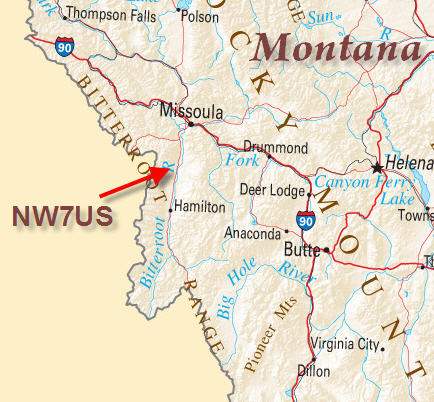
Howdy! I am pleased that you have chosen to visit my website. This website is dedicated to
information and
resources regarding:
- Medium Wave (MW),
- Shortwave (SW), better known as High Frequency (HF)
radio communications. Some of the information is also aplicable to very high frequencies (VHF) and above, as well as the longwave radio spectrum. It is also about me. This site is an extension of that which I have learned, gathered, and wish to share with you. It is a personal hobby and effort that I present during my spare time.
High Frequency refers roughly to those radio frequencies between
1800 Kilohertz, and
30 Megahertz. Sometimes, this range of frequencies is referred to as
Shortwave. A
Shortwave Radio, then, would be a radio receiver capable of tuning frequencies in the
HF range.
Medium Wave is just below HF, but above longwave (LW), or 520 KHz (roughly).
I do try to cover other information not directly related to the phenomena, activities, modes, etc. of HF radio. My personal passion in the Radio Hobby is that which involves Shortwave!
The Website's Focus
Overall, then, this website is my personal collection of information, links, and other resources related to
Amateur (HAM) Radio,
HF Communications, and related areas of interest. You are most welcome to explore the site and to participate in the
guest book. It is an evolving website, the goal of which is to educate and support you in your journey through the hobby of Ham Radio and / or shortwave listening. Your feedback is greatly appreciated and solicited.
What (or, Who) is NW7US?
 NW7US
NW7US is the
Amateur Radio call-sign issued by
the Federal Communications Commission to my
Ham Radio Station, conferring the right to operate this equipment under certain privileges. This call-sign is assigned to me as both an identification of my Amateur Radio station, as well as a reference to those privileges I have been granted after having passed both a series of written examinations which cover rules, procedures, technical theory, and related knowledge, and a series of morse code (cw) proficiency tests.
I'm Tomas Hood. I am an Amateur Radio Operator. I also own a computer service shop and store, called, 'Sapphire Website and Computers Services', in Stevensville, Montana. I have been in the computer industry since 1983. One of my computer 'hats' is 'programmer'. I can program in Perl, PHP, XML, WAP/WML, HTML, C/C++, VBA, SQL, and so forth. I design web sites and applications.
I also enjoy a good
Louis L'Amour book (like the
Sackett Series, or the Walking Drum, or the Hopalong Cassidy Novels).
You can see some photographs of my Radio Shack, and other things on my
Shack and Photo Album page. I will add more photographs over time. I will also start adding other links that take you to content I feel is good, educational, entertaining, and in general stuff that I like. This will help you get to know me more.
I also write for four radio magazines. I write the monthly propagation columns for both
Popular Communications as well as for
CQ Magazine. Quarterly, I write for
CQ VHF. Once and a while I write a propagation article for
Monitoring Times (for instance, see April 2007).
I am starting to contribute to the WikiPedia project, in the Amateur Radio section. I'll share more about that, soon.
A Short History of My Shortwave / HAM Interests and Activities
When I was about nine years old, I got a hold of my parent's Sony Multiband Portable radio. I cannot remember which model. But it had four bands,
FM,
AM,
LW,
SW. I soon discovered that the
SW selection held very strange and somewhat exotic sounds and stations. As you might have guessed from above,
SW stands for
Shortwave (
LW is for
Longwave those frequencies below 530 KHz,
AM is for the
Amplitude Modulation mode, which is what is used in the
domestic broadcast band (between 530 KHz and 1750 Khz or so), and
FM (
frequency modulation), the popular band of radio spectrum that everyone seems to enjoy, with music, talk, and other formats).
Shortwave describes the size of the radio wave used to transmit the signal that the radio can tune and listen in on.

As I began to discover not only odd, interesting noises and pops, whistles, and alien-like sounds, but also a great variety of radio stations from all parts of the world, I became deeply interested in the technical aspects of what made this little radio achieve such great magic. It seemed very magical that the
BBC (England),
RSA (Radio South Africa),
CBC (Radio Canada International),
Radio Australia, and so many more exotic stations, could be heard by me in the middle of Montana's Rocky Mountains. Hearing these signals lured me into listening and learning more about
Shortwave Listening to the point that I was hooked for life.
I tried to get books about radio, electronics, and related information. Hard to come by for a nine-year-old. But I did get some support from my parents and friends, school, and library. I studied that until I knew it forward and backward. Tube theory, transistors (which were still a newer concept to the general consumer market, in the early 1970's), resistors, capacitors, and all the other doo-hickies and thing-a-ma-bobs that made all this magic of radio come into being.
In the mid-seventies (around 1976 and 1977), I lived in Salt Lake City, Utah. There, I learned directly about
Ham Radio. I started to pro-actively learn my
morse code. But, due to my dad's orders to relocate to a new duty station (he was in the
US Army), I did not have a chance to complete my study and obtain my Amateur Radio license. But I did continue studying radio theory and my hobby of Shortwave Listening. I even got a hold of the
First Class Commercial Class study materials for the
First Class Radiotelephone Commercial radiotelephone license.
US Army


After a number of years and after graduating from High School, I also entered the
US Army. I became a
31M, known as the
Multichannel Communications Equipment Operator. But I had a chance to do more than just that MOS. I also worked with
Satellite,
Troposcatter,
Microwave, and
HF radio modes and equipment (as well as computers).
After being trained as a
31M at Fort Gordon, Georgia, I was stationed in Germany. These pictures are of troposcatter dishes, out in the field. We spent a lot of time out there. Months at a time! And I ended up making
rhombics,
inverted dipoles, and other great
hf wire antenna configurations.
I received two
Army Achievement Medals for my efforts at helping my unit accomplish its mission. I was instrumental in engineering a communications network that they had been attempting to secure for many years. In addition, I created an
SOP (
Standard Operating Procedures) manual including the use of Antenna and HF equipment to aid in engineering the communications network.
Connecticut (1989-1991)
After spending a few years in Germany, I moved to Connecticut. I was hired by
The Travelers as a programmer / analyst, and found out that my team leader was an Amateur Radio operator. It was a natural progression for me to end up (finally!) licensed as a
Novice-class Amateur! The same year, I upgraded to the
Coded Technician (at that time, there was no such thing as a Technician Plus and No-Code Technician. There was just a Technician, which required 5 wpm code, and the Technician written element. My call was
KA1VGL. I loved getting on and doing CW as well as 10 meter voice! The Solar cycle was at a peak (this was 1989). I talked to the whole world on 10 meters (28 MHz). I think I worked 67 countries. I was really excited.
Montana (1991-1992)
After a bit of time in Connecticut, I moved to Montana. I drove up to Canada, and then over to the Great Lakes, then made my way back into the States and over to Montana. I had a 10 meter rig (Radio Shack's HTX-100), and talked again, all over the world from the car!
The trip included days when the Aurora was active, and I could see them while being near the Great Lakes. Stations were active on 10 meters all night long, at times, during this trip! It was a very excellent experience. (And the Canadian Hams extended a lot of hospitality.)
After settling down in Forsyth, Montana, I setup my radio shack with a long wire for most bands, and a vertical for 10 meters. I notified the FCC that I had a new address and location, and that I needed a new call sign to reflect my location. My first call,
KA1VGL, was issued for the 1 call area. Montana is in the 7 call area. Call areas are geographical areas in the United States, numbered from 0 to 9. The FCC issued me my new call as
N7PMS. Since I was in Montana, I became known as "November Seven, Pesky Montana Skunk." Better than other names... PMS.. etc.

Washington (1992-2007)
After about a year in Montana, I decided that I should head out to the state of Washington. More job opportunities. This was at the end of the Gulf War, so the economy was a bit slow. My brother who was stationed in Washington (US Army) told me that I ought to come to Washington as I might have a chance to work at Microsoft, or something along these lines.
So, I relocated to Olympia, the capitol city of Washington state. While in Olympia, on April 23, 1998, I upgraded to Advanced. I also passed my 20 wpm code element for the Amateur Extra. In June of 1998, I passed the written for Amateur Extra. I was very happy to finally make it so that I had access to the entire Ham spectrum! It is great to be able to have use of the radio frequencies assigned to the Ham Radio hobby. On June 2, 1998, the FCC granted me a new Vanity Call. I am now
NW7US, reflecting that I am in the Pacific North West of the Seven Call Area, in the United States.
Right after the upgrade to Extra, I took a job with a start-up in Seattle, called, Greatergood.com (formerly YourSchoolShop.com) (They are now extinct). I was the primary Web Master and Programmer / Analyst. (You may see my
resume here). I spent a year in downtown Seattle, working HF with my Outbacker and a TS-830S / IC-706MKIIG.

While I lived in Seattle (1998, 1999), the
antenna farm was mostly an Outbacker Marine (two section), without the WARC bands, or one of the five resonated Hustler mobile antennas. They are comparable in performance on 20 meters and higher. But on 80 and 40 Meters, the Hustlers seem to perform just a bit better. However, I tended to use the Outbacker in the apartment setting more often due to its easier operation with my limited ground radial situation. On the car, I tended to favor the Hustlers.
Occasionally, I used (you'll love this) my
patio railing, and the
trim around my apartment. I was on the fifth floor apartment (top floor) with a great view of the Space Needle in Seattle, Washington. I have talked to Russian stations, over the North Pole, and many other stations around the world. It is amazing what one can do! Of course, I had to use the
MFJ-1026 to cancel out the high noise I had there.
Views from the Seattle Patio where the Outbacker was:


My Current Station - Stevensville, Montana

After spending years in Washington (and doing quite a bit in Amateur Radio and US Army MARS), I finally had a chance to move back to Montana. I will update this part of my
About page as time allows.
My antenna is a single dipole antenna with dipole wires for 80, 40, 30, and 20 meters, which also allows me on higher bands like 15 meters. With a tuner, I can work all bands above 80 meters. I do plan on raising a 160-meter antenna sometime in the spring.
My main HF radio is an Icom IC-7000. It allows me a lot of flexibility, in that I can use it portable, mobile, or in my home. Using a laptop with an interface between the computer and radio allows me easy portability and operation on digital modes such as PSK-31 or Olivia. I am very active on Olivia and PSK-31 modes. I am interested in QRP operation, and CW operation, in addition to the digital modes.

Also, I am using two
World War II Navy Straight Key. One is
CMI-26003A, meaning, C for Contracted Out, MI for Molded Insulator (the company that was contracted to make the key), 26 for Straight Telegraph Key, and 003A for the model number and revision. The other one is a CJB26003A - made by J.H. Bunnell. Here is a website that shows you how to decode these keys:
The Telegraph Office: U. S. Navy Telegraph and Wireless Keys.
I also use a side-to-side paddle. It is a modified Vibroplex key, from about 1920. I use it while mobile, too. See
my pictures of this key and installation.
My wife, and the fourth of our four children, now live here in Stevensville, Montana. The other three of our children are now adults and are living out their lives in various places.
Nathon, my youngest son from my previous marriage, but now my second youngest son, passed his Technician License when he was 12 years old. His call is KD7NHF. My daughter, Ashley, is now KD7QKT. She passed her license at 14 years of age - just before her birthday that year!
My wife is now licensed as KD7TZR. She passed her test the same day as my oldest son, Atreju, pass his. Atreju is now KD7TZQ.


 Regarding my Amateur Radio hobby: I'm currently an Amateur Radio Extra Class operator. I've been an Extra Class operator since the 1990's.